
UK Autumn Budget 2026
What it could mean for your financial plans
Budget date: 28 October 2026
THE BIG PICTURE
The Budget combines short-term cost-of-living support with changes to the taxation of savings, property income and business disposals. In response to the budget, it is important not to make rushed decisions, but to review how savings, pensions, investments and future business or property plans fit together.
Key announcements at a glance
What this may mean for your financial planning
1. Cash savings and investments
Keeping the £20,000 cash ISA allowance is helpful for people who value certainty and tax-free interest. The planned increase in tax on savings income from April 2027 may make the tax treatment of cash deposits more important, particularly for higher-rate taxpayers and people with substantial taxable savings. The Government says most people will not pay more tax on savings, but the impact depends on the amount and type of interest received and your wider income.
2. Pensions and retirement income
The Budget announcement on the new Pension Tax Allowance could be relevant to people whose total income is close to the full new State Pension. The final eligibility rules and interaction with other taxable income will matter, so a review of your overall financial situation should be done before making any decisions.
When drawing pension income, it remains important to plan withdrawals in the most tax efficient manner taking into account your overall situation, goals and objectives.
3. Business owners and entrepreneurs
Reducing the BADR lifetime limit to £500,000 could increase the Capital Gains Tax bill for some business owners selling qualifying shares or business assets after the change takes effect. The proposed Founders’ Relief is aimed at a narrower group of qualifying founders of larger, growing UK businesses, with demanding ownership, residence, trading and growth criteria. It is a proposal subject to consultation, not a relief that should be assumed to apply.
Before a sale, succession or restructuring is implemented professional advice should be obtained. Any decision about timing should be based on commercial realities, legal requirements and the detailed legislation—not tax alone.
4. Property owners and landlords
The planned 2-percentage-point increase in tax rates on property income from April 2027 may reduce the net return for landlords with taxable rental profits. The impact will depend on ownership structure, allowable expenses, financing and each owner’s wider tax position. Selling or transferring property can trigger tax and legal consequences.
5. Inheritance tax and family planning
The Budget includes changes to the Inheritance Tax treatment of certain liabilities connected with property held in trust, intended to align their treatment with rules applying more generally. Trusts and estate plans should therefore be reviewed where relevant, particularly if borrowing or liabilities are associated with settled assets. Existing arrangements should not be changed without specialist advice.
6. Household costs and business planning
Temporary measures affecting energy bills, Council Tax and fuel duty may provide some near-term relief. These measures do not remove longer-term uncertainty around inflation, interest rates or household budgets. Business owners should also review the practical impact of capital allowance changes with their accountant before bringing forward or delaying investment.
Practical next steps
- Review taxable cash interest and consider whether available ISA allowances are being used effectively.
- Check your retirement-income plan, especially if income is close to tax thresholds or the full new State Pension.
- If you own a business or expect a sale, seek early advice on BADR, the proposed Founders’ Relief and transaction timing.
- If you receive rental income, model the potential effect of the proposed tax-rate change from April 2027.
- Ask your adviser to review relevant trust or estate arrangements in light of the IHT announcement.
Our perspective
The Budget reinforces the value of coordinated financial planning: the right decision will depend on your income, assets, tax position, time horizon and family or business objectives. Some measures take effect immediately, while others are planned for April 2027 or remain subject to consultation and legislation. We recommend reviewing changes in the context of your overall plan rather than making decisions in response to headlines.
Should you have any concerns, queries or would like to discuss any matter relating to the budget or your financial planning in general please contact the office and we will be pleased to arrange an appointment to ensure that any issues are addressed and you remain on course to achieve your goals and objectives.
Darren Fuller -Clear Senior Paraplanner
Not the Hunger Games
Source:Odeon Cinemas
In The Hunger Games, every year, 24 children are sent into an arena to fight to the death. Considering this is a series aimed at kids, this is rather bleak! Before the kids go in every adult uses the phrase “may the odds be ever in your favour.”
But, given that only one comes out alive, that’s a one-in-twenty-four chance of surviving. So around 4%; the odds are definitely NOT in your favour.
But with stock markets, it’s the other way round. The odds really are in our favour. Yet we often behave as if we’re in the arena, fighting to the death.
That’s because there often seems to be a voice telling us “sell”. After a bad year it’s “get out now, before you take any more pain”. After a positive year it’s “get out now, while you’re up”.
String a few positive years together like we’ve just seen and it’s saying “well, now the odds really can’t be in your favour”
Loss aversion is real. The psychology of loss aversion came around when the human existence really WAS like the Hunger Games, hundreds of thousands of years ago. Mess up, and that’s it, the game was over!
There is a case for having some stats ready in order to overrule the instincts of the scared child in the investment arena and keep investing through good years, and bad.
Good years:
Over the past 50 years (since 1976), when the Morgan Stanley Capital International (MSCI) World index has had an up year, the next year is also positive 73% of the time, with an average return of 8.5%. Good usually follows good.
Down years:
After a down year, your odds get even better! Following a down year is positive 83% of the time, with an average return of nearly 12%.
And if you expand your horizons, the odds improve further.
Down Year That Year Next Year After 3 years After 5 years 1977 -2% 13% 47% 43% 1981 -8% 6% 28% 143% 1990 -19% 16% 30% 59% 1992 -7% 20% 48% 88% 2000 -14% -18% -15% 3% 2001 -18% -21% 17% 48% 2002 -21% 31% 59% 101% 2008 -42% 27% 29% 81% 2011 -8% 13% 45% 48% 2015 -3% 5% 13% 62% 2018 -10% 25% 72% 68% 2022 -19% 22% 70% Source: 7IM/LSEG Workspace. Shows price returns of MSCI World (excluding dividends). Past performance is not a guide to future returns
Three years after a down year, the MSCI World has been in positive territory 92% of the time, and after five, that figure is 100% – although, let’s be honest, following 2000, it’s only just positive …
Unfortunately, every year throws up something scary which throws us back into the Hunger Games mindset. This will not change. Nor will our psychology.
But unlike Katniss Everdeen, we don’t actually need to do anything (whether that’s sell, or overthrow the global order).
When the odds ARE in your favour, all you have to do is wait.

Source :The Hunger Games
Trending Tuesdays
Humans like the comfort of consensus.
It could be Matcha, Beanie Babies or Crocs, we are often guided by what other people are doing. If everyone is buying something, it feels safer to buy. If everyone is selling, it feels safer to sell. Even if that thing is pretty dreadful …

Source: Crocs/Marketplace.org
Investors are no different – People follow people, money follows money and trends form.
Trends, more often than not, form when markets are looking a little bit scary.
For example 2008.
The S&P 500 (Standard and Poors) lost 49% from peak-to-trough. Worrying.
But. The average return for the 52 Tuesdays in 2008 was up 0.44%. Every other day of the week had a negative average.
Average Daily Return, 2008 Full year Return Monday -0.31% -17.0% Tuesday 0.44% 23.5% Wednesday -0.62% -29.6% Thursday -0.20% -11.4% Friday -0.01% -3.8% Source: FactSet/7IM.
In fact, if you’d have just invested in the market on Tuesdays (buying at the start of the day, selling at the end), the total return in 2008 would have been 24%! The same thing was true in 2020 with Covid, and that’s is true for the FTSE 100 as for the US market. This is everywhere!
So, what’s going on?
Queues lining up to buy Crocs or Matcha, line up to panic about markets:
Investors get nervous about something on Thursday. They stew on it all weekend – lots of deep-dive news stories into whatever conflict/crash/catastrophe is causing the worry. As Japanese markets sell off overnight on Sunday, everyone to think their worst fears are coming true.
European markets sell off. Then the US wakes up, sees a lot of panicked sales, and starts buying overnight on Monday. By Tuesday, everything has calmed down.
… and then of course, Thursday comes around again.
This is not a proposal to move to a one-day a week investment strategy, we do not believe that the masses will keep wearing Crocs.
But, what we do know is that trends don’t last forever:
S&P 500 , Average Return, 2026 Monday 0.32% Tuesday 0.02% Wednesday 0.02% Thursday 0.03% Friday 0.34% Source: FactSet/7IM.
2026 could well be the year of Tepid Tuesday.
Source:7IM
Index Subscriptions
It’s always a delight when Slow Horses is on our TV screens.
If you haven’t spent any time watching Gary Oldman’s portrayal of over-the-hill spy Jackson Lamb, you really, really, really should:

Source: Apple TV
The 2027 streaming service shuffle begins!
Netflix has got Bridgerton next year, Prime –Tomb Raider, HBO Max-The White Lotus (season 4), Disney+ has Pokémon and Daredevil and then Ted Lasso on Apple TV (allegedly).
When? Which service? How do you keep track? “Is there a free trial? How long will it last? And will you remember to cancel it in time?” (Good question).
Investing actually has a similar problem when it comes to indices.
Because, due to tradition and habit and history, index investing is a mess. Different providers dominate different parts of the world (much like series exclusives). By this we mean the most liquid and most commonly referred to index for a given country. For example the S&P United Kingdom index (82 stocks), in the US FTSE USA (483 stocks).
Interestingly, Greece is the only country ever to get relegated by MSCI, (Morgan Stanley Capital International) and then promoted again.
This means
- UK: FTSE 100 – managed by FTSE Russell.
- Europe: Euro Stoxx 50 – managed by STOXX
- US: S&P 500 – managed by S&P Dow Jones
- Emerging Markets: MSCI EM – managed by MSCI
And they don’t always agree on the key hits!
For example, for S&P, FTSE and Stoxx, Greek stocks entered the “Developed Markets” catalogue in September this year. But not many people noticed. This was because for the Emerging Market index that really matters – MSCI EM – Greece’s new “Developed” season doesn’t debut until May 2027. That’s without what’s happening to Indonesia!
Finally, none of the providers’ announcement dates align with the other which is not exactly helpful.
Index provider
Review schedules
FTSE Russell
March, June, September, December
STOXX
Quarterly/monthly
S&P Dow Jones
No schedule!!
MSCI
February, May, August, November
Source: FTSE Russell/STOXX/S&P Dow Jones/MSCI
Index investing remains one of the simplest ways to own a broad slice of the world,
but in the same way that there’s no “best” streaming service, there’s no “best” index. Every provider has its own catalogue, classifications and release schedule.
Back to Slow Horses before the free trial ends …!
Source:7IM
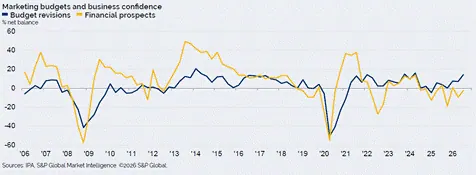
UK Marketing budget growth at it’s strongest since Q2 2024 Key findings Q3 2026:
• Strongest upward revision to total marketing budgets in nine quarters
• Public relations and events budgets lead growth
• Financial prospects at company and industry level turn less negative
Interesting financial facts The earliest forms of money were alive, edible or completely moveable! Before coins were minted, ancient societies used everything from livestock to blocks of compressed tea leaves to trade for goods.

- Shell money -Cowrie shells were used for thousands of years across Asia, Africa and the Pacific as currency. Actually, the Chinese character for “money” or “trade” (貝) is a stylized drawing of a cowrie shell.
- Stone discs – On the island of Yap (part of the Federal States of Micronesia in the Pacific), people used giant stone discs – Rai stones, which were up to 12 foot wide. As they were too heavy to move, the transactions were conducted by changing ownership in conversation. Even if they broke or sunk in the ocean.
- Edible currencies – Citizens of ancient China used compressed blocks of tea leaves as currency. The blocks were stamped with values. In Mesoamerica, the Aztecs valued cacao beans so highly that people created counterfeit beans out of painted clay!
Source: Google